
Forthcoming books
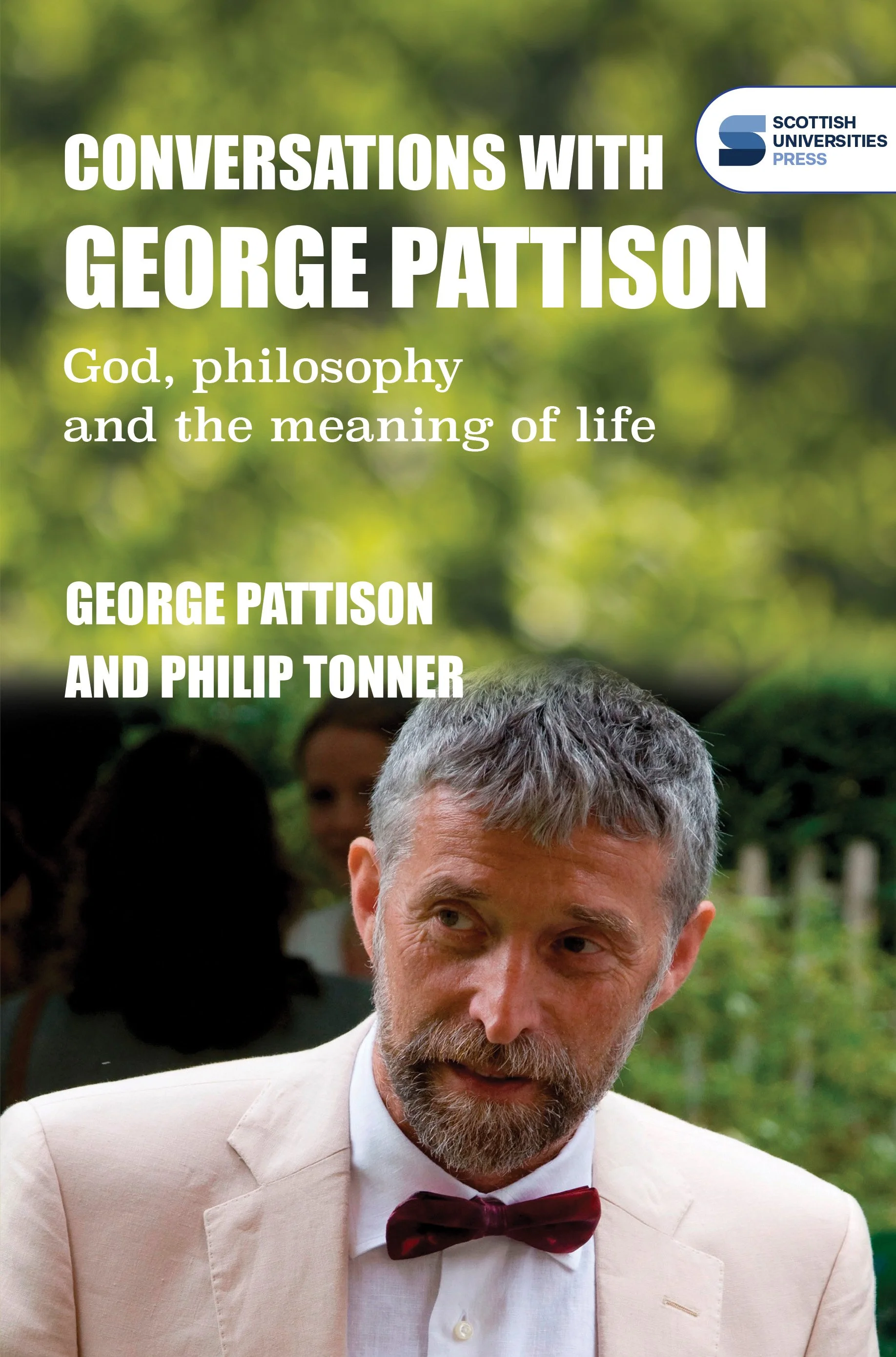
Conversations with George Pattison: God, philosophy and the meaning of life
George Pattison and Philip Tonner
George Pattison is an internationally recognised theologian and philosopher. Over the past four decades, he has not only advanced thinking and research within the discipline of theology but also made significant contributions to a wide range of debates in philosophy, existential thought, art and aesthetics, technology, modernity and faith, mysticism, religious studies, and the life of the Anglican Church. Characterised by a series of highly original attempts to synthesise and develop ideas and concepts from theology, philosophy, phenomenology, education and aesthetics, his work is innovative, accessible and engaging. It offers an original perspective on, among other topics, the devout life, prayer, hope, what it means to be human, and God.
This first book-length introduction to his thought provides a highly accessible and comprehensive account of Pattison's life and career in the form of a set of interviews he gave to Philip Tonner, a philosopher based at the University of Glasgow. The interview format allows Pattison to present his ideas in his own words, and the book covers the entirety of his career, from his earliest publications to his most recent collection of essays, A Philosophy of Prayer: Nothingness, Language, and Hope (2024). It includes new reflections on some of his key influences; Kierkegaard, Heidegger and Dostoevsky.
Publication date: Thursday 22 October 2026
-
George Pattison is a retired Anglican priest and scholar. After thirteen years as a parish priest, he taught in the universities of Cambridge, Aarhus, Oxford, and Glasgow and has held visiting fellowships and posts at universities and research institutes in the USA, Denmark, Germany, and France. He has published extensively on existential philosophy and theology and has recently taken up the editorship of the journal Theology. He now lives in North Devon.
Clare Carlisle is the author of eight books on philosophy and philosophers, including Philosopher of the Heart: The Restless Life of Søren Kierkegaard, The Marriage Question: George Eliot’s Double Life, and most recently Transcendence for Beginners (her Gifford Lectures on life writing and philosophy). She grew up in Manchester, studied philosophy and theology at Trinity College, Cambridge, and now lives in Hackney. She is Professor of Philosophy at King’s College London.
Philip Tonner is the author of three books, Heidegger, Metaphysics, and the Univocity of Being, Phenomenology Between Aesthetics and Idealism, and Dwelling: Heidegger, Archaeology, Mortality. He is co-author with Tim Ingold, et al, of Conversations with Tim Ingold: Anthropology, Education and Life, also published by SUP. Philip grew up in Glasgow, studied philosophy at the Universities of Glasgow and Warwick, and archaeology at Kellogg College, University of Oxford. A former teacher, he is now Senior Lecturer in the School of Education at the University of Glasgow.
-
Preface
List of Figures: Figure 1. George Pattison.
Introduction, Philip Tonner
Conversation 1: Life and Career.
Conversation 2: Existence, nothingness, and God.
Conversation 3: Kierkegaard, Heidegger, and Dostoevsky.
Conversation 4: A Philosophy of Christian Life.
Conversation 5: Living forwards, understanding backwards.
Responses
Kierkegaard’s Queerness: A response to Conversations With George Pattison, Clare Carlisle
Response to Clare Carlisle, George Pattison
Appendix: Into the Future: An interview with Professor George Pattison (May 2016).
New voices on Adam Smith’s politics, philosophy, and economics: Essays marking the 250th anniversary of The Wealth of Nations
Edited by Ana Paula Londe Silva, Leo Steeds and Craig Smith
Published to mark the 250th anniversary of The Wealth of Nations, this volume brings together a new generation of international scholars to reassess the full breadth of Adam Smith's intellectual legacy. Emerging from a series of workshops held between 2023 and 2025 as part of the University of Glasgow's 'Adam Smith @ 300' project, its fifteen chapters span political theory, moral philosophy, economics, history of ideas, and cognitive science, reflecting the genuinely interdisciplinary character of Smith's own thought. Contributors examine Smith's engagement with predecessors and contemporaries including Mandeville, Hume, Rousseau, and Hutton; trace the reception and translation of his work in Germany, China, and Japan; revisit longstanding debates over materialism, inequality, colonialism, and political authority in his theory; and bring his ideas into dialogue with contemporary challenges from democratic erosion and environmental crisis to the politics of anger. The result is a portrait of a thinker far richer and more contested than the patron saint of free markets, and a demonstration of the vitality of Smith scholarship today.
Publication date: Winter 2026
-
Leo Steeds is currently a Research Associate on the ‘Market economies and green ideals’ project at King’s College London. He was previously Research Associate on the “Adam Smith at 300” project at the University of Glasgow. He holds a PhD in Politics and International Studies from the University of Warwick, an MA in International Political Economy from the University of Warwick, and a BA Hons in Music from the University of Oxford. His research centres around the challenges to established modes of understanding the relationship between politics and economics presented by today’s environmental crisis, with a special focus on the thought of Adam Smith. He is an Associate Editor of the Adam Smith Review.
Ana Paula Londe Silva is currently a postdoctoral fellow at the Universidade Federal de Minas Gerais, where she coordinates the research project Political Economy and Abolitionism: Public Debate and Slavery in Brazil During the First Half of the Nineteenth Century. She was a research associate on the “Adam Smith at 300” project at the University of Glasgow between 2023 and 2025. She holds a PhD in Economics from the Universidade Federal de Minas Gerais and an MA in Economics from the Universidade Estadual de Campinas. Her research concentrates on the history of political economy, antislavery, and abolitionism in the eighteenth and nineteenth centuries, with a recent focus on the circulation of economic ideas. She is an Associate Editor of the Adam Smith Review.
Craig Smith is Professor of the History of Political Thought at the University of Glasgow. He has written widely on Adam Smith and the Scottish Enlightenment. He is the editor of The Adam Smith Review.
-
Preface, Craig Smith
Introduction, Ana Paula Londe Silva and Leo Steeds
Part I. Thinking with (and against) others
1. Mandeville, Hume, and Smith on the political judgement of the poor, Zack Rauwald
2. Wealth and power in Hobbes and Smith: the reconfiguration of a modern problem, Thiago Vargas
3. Mechanism, mountains, and moral philosophy: James Hutton, Adam Smith, and the economy of nature, Ann Columbia Campbell
4. Adam Smith’s response to the Rousseauian morality of amiability: recontextualising the Smith-Rousseau problem through the lens of Japanese scholarship, Hiroki Ueno
5. Adam Smith’s engagement with the public debate on imperial political economy: lessons from his library, Ana Paula Londe Silva
Part II. Afterlives: reception and translation
6. From the division of labour to social differentiation: Smith, Simmel, and the development of sociological thought, Maximilian Priebe
7. Beyond the translated text: Yan Fu’s marginalia in the source text of The Wealth of Nations, Qing Guo
Part III. Theoretical interpretations and controversies
8. Revisiting the materialist interpretation of Adam Smith: from economic determinism to the limits of the material, Leo Steeds
9. The problem of normativity in Adam Smith’s history and theory of natural authority, Yuchen Sun
10. Adam Smith on inequality and poverty, Eveline Hauck
11. Adam Smith and the vulnerability of commercial societies, Julia Fleider Marchevsky
12. The other of progress: Adam Smith on Amerindian societies and European settler colonialism, Ivan Prates Sternick
Part IV. Smith and the challenges of the 21st century
13. Adam Smith in challenging contexts: on the corruption of moral sentiments and human progress, Thaís Alves Costa
14. Anger in politics today: lessons from Smith’s sentimentalist approach to justice, Hiroyuki Ota
15. Embodied practice and interactive engagement: Adam Smith’s dynamics of imagination, Felipe Gonzalez T. Machado
Poverty in Scotland 2026. Delivering the promise?
John H. McKendrick and Stephen Sinclair
Poverty in Scotland 2026 is the eleventh edition in a series produced by the Scottish Poverty and Inequality Research Unit (previously in partnership with the Child Poverty Action Group) since the early 1990s. Each edition is published in a Scottish Parliamentary election year to inform public debate and propose policy options to reduce poverty and deprivation. Across 31 short and accessible chapters, contributors analyse policy developments, comment on progress across multiple dimensions of poverty over the last Parliamentary term, and propose policy and practice reforms to make further advances in the next 5 to 10 years.
Poverty in Scotland is a unique publication which, over the course of 30 years, has established a reputation as an authoritative, esteemed and influential contribution to social policy analysis and public debate. A defining and distinctive feature is that it straddles divisions between academic and lay contributors and readership, giving voice to a range of experts providing informed comment on multiple aspects of social policy.
Publication date: Winter 2026

-
John H. McKendrick - Professor in Social Justice and Co-Director the Scottish Poverty and Inequality Research Unit (SPIRU) at Glasgow Caledonian University. He is also the national Commissioner for Fair Access. He has edited five previous editions of Poverty in Scotland.
Stephen Sinclair - Professor of Social Policy and Co-Director the Scottish Poverty and Inequality Research Unit (SPIRU) at Glasgow Caledonian University and a Fellow of the Academy of Social Sciences. He is also Chair of the Poverty & Inequality Commission, Chair of the editorial board of the Journal of Poverty & Social Justice and a member of the UK Child Poverty Action Group policy committee.
-
Introduction: An End In Sight?
Stephen Sinclair
1. Foundations - A Twenty-One Point Q&A Guide to Poverty in Scotland, John H. McKendrick
2. The Scale of the Challenge – A Twenty Point Q&A Guide to Extent of Poverty in Scotland, John H. McKendrick
3. Child Poverty, John Dickie
4. Turning the Tide: Strategies to Prevent and Eradicate Poverty among Scotland’s Single Parent Families, Marion Davis and Satwat Rehman
5. Women and Poverty, Susan McKellar and Agnes Tolmie
6. Black and Minority Ethnic Communities, Sholen Macpherson and Lucien Staddon Foster
7. Disabled People and Families, Tressa Burke
8. Carer Poverty in Scotland, Shubhanna Hussain
9. Pensioners and Older People, Eileen Cawley
10. Care Experienced, Kenny Murray
11. Justice System Experienced, Lindsay Fyffe-Jardine
12. Communities and Neighbourhoods, John Halliday
13. Local Government, Peter Allan
14. Poverty in Rural and Island Scotland, Artemis Pana
15. Arts and Culture and Poverty, Fiona Doring
16. Play and Poverty in Scotland, Jenny Wood
17. Sport and Poverty in Scotland: A Tool for Change, Kirsty McNab
18. Climate, Jamie Livingstone
19. Fuel Poverty: It is Much More Than The Choice Between Heating or Eating, Frazer Scott
20. Housing, Susie Fitton
21. Transport, David Kelly
22. Food Justice: Reimagining Scotland's Response to Food Poverty, Mandy Morgan and Neil Young
23. Poverty, Education and the Limits — and Power — of Schools, Eireann Eadon McAuley
24. Employment and Prevention in Scotland: From Good Jobs to Good Systems, Sean Duffy and Victoria Carson
25. Childcare as a Catalyst: Scotland’s Progress and Priorities in Tackling Child Poverty, Heather Douglas
26. Poverty and Health, Rachel McAdams
27. Debt, Martin Canavan
28. Values First: What Adult Disability Payment (ADP) Reveals About Scotland’s Evolving Social Security Framework , Erica Young
29. The Role of Lived Experience in Poverty Policy Making in Scotland, Paul Pearson and Laura Robertson
Conclusion: Prospects, priorities and possibilities, Stephen Sinclair and John H. McKendrick
Archaeological housework: Excavating the avocational archaeological atelier of Fiona Gorman, Isle of Arran, Scotland
Nyree Finlay
Part excavation and part house clearance, this contemporary archaeological collection study documents the recovery of an unusual heritage assemblage. It involved the recording of domestic workrooms on the Isle of Arran, Scotland. Central to the analysis is the stratigraphy of a forgotten worktable and repurposed containers.
Belonging to Fiona Gorman, avocational archaeologist and former art teacher, the collection comprises an extensive assemblage of found objects. Along with friends she discovered significant new prehistoric sites on Arran through systematic field-walking and landscape reconnaissance. Other items in the collection reveal the convivial and inter-generational attraction of stone gathering with close friends and family and creation of museum displays.
A celebration of recreational heritage participation, it documents domestic curation and repeat cataloguing practices. A unique collection of later dementia works prompts exploration of earlier embodied traces in creative display practices alongside the art and archaeology of assemblage making.
Archaeological housework promotes archaeology as affective care and explores the wider disciplinary neglect of its materialities and indoor practices through one woman’s passion for art, archaeology and the ancient landscapes of her island home.
This book will be published open access under a CC BY-NC Licence.
Publication date: TBC

-
Nyree Finlay is Senior Lecturer in Archaeology at the University of Glasgow and convenor of the MSc Material Culture and Artefact Studies.
Drawing on a background in Scottish and European prehistory, her research practice centres around lithics using experimental and recursive sensorial assemblage analysis to expose enduring engagements with lithic technologies, craft skill, and stone as mnemonic media.
Other areas of research include gender, personhood, age, the lifecourse, gatherer-hunter archaeological sites and work realising various legacy excavation and collection projects. Current writing, exhibition and installation works includes new directions in the archaeologies of dementia, embodied care, creative knowledge practices and relational (re)collections.
-
Acknowledgements
Introduction
Beginnings, people and place
Homework: recording an avocational atelier
Housework: Alt Beag
Housework: Burnbank
The table
Creative display
Reassembling stone practices
The materiality of dementia
Coda: an ending of sorts
Glossary
References